
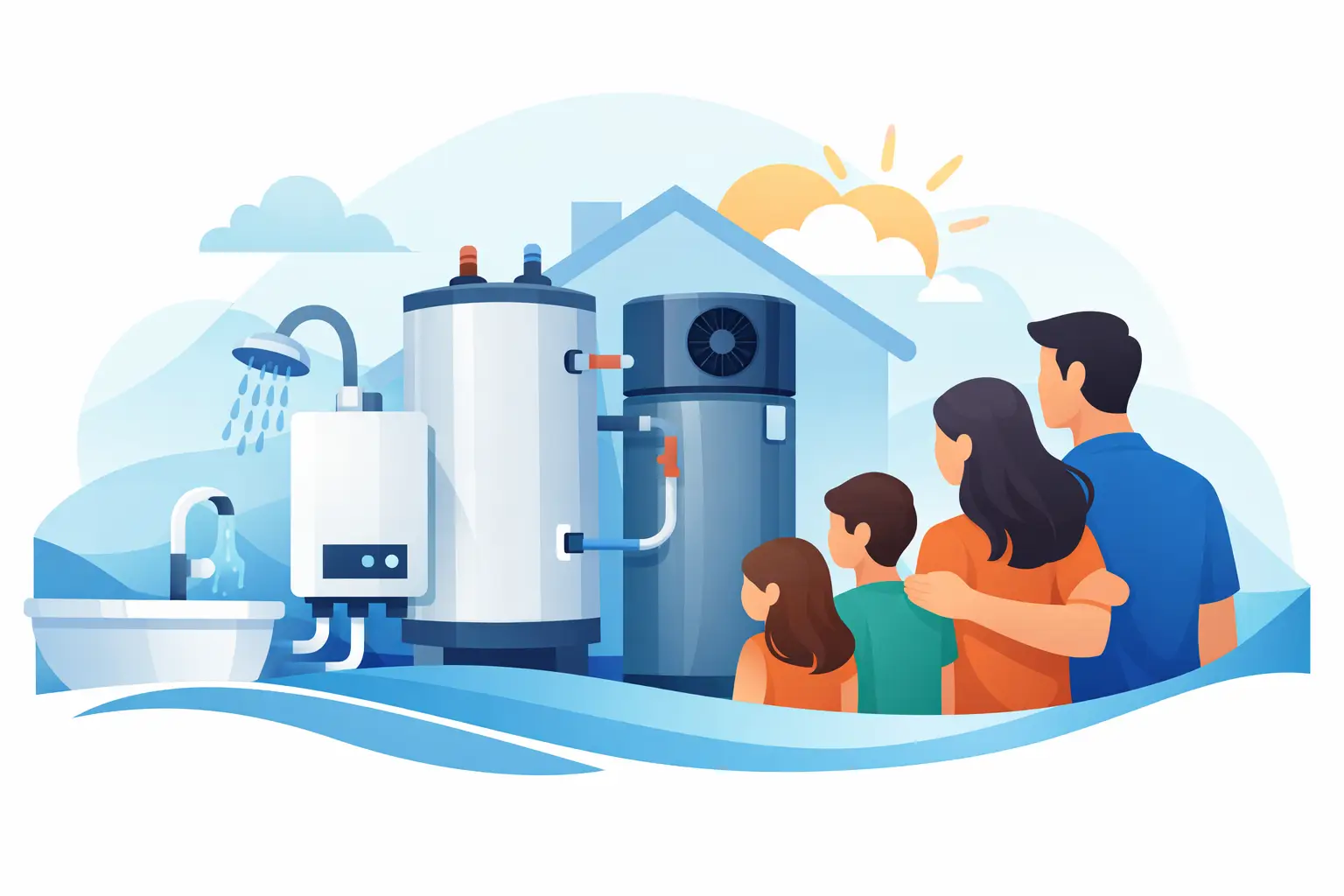
When five or more people are showering, running laundry, and filling the dishwasher in the same morning, a standard water heater can fall behind fast. Choosing the best water heaters for large families is less about brand names and more about capacity, recovery rate, fuel type, and how your household actually uses hot water.
A family of six does not always need the same system as another family of six. One home may have back-to-back showers before school and work. Another may spread usage throughout the day. That is why the right choice starts with demand, not marketing claims.
What large families actually need from a water heater
Large households usually need three things at once – enough stored or produced hot water, fast recovery, and dependable performance during peak use. If your water heater can handle one long shower but struggles when someone starts a second, that points to a sizing or recovery problem.
The main mistake homeowners make is focusing only on tank gallons. Tank size matters, but first-hour rating matters just as much. First-hour rating tells you how many gallons of hot water a unit can deliver in an hour when starting with a full tank. For families, that number often gives a more realistic picture than capacity alone.
If your home has a large soaking tub, multiple bathrooms, or teenagers who take long showers, your demand may be higher than you think. The same goes for homes that run appliances with hot water during the busiest parts of the day.
Best water heaters for large families by type
High-capacity traditional tank water heaters
For many large families, a 75-gallon tank water heater is the most straightforward answer. It is simple, familiar, and often more affordable upfront than other options. In homes with gas service, a high-input gas tank model can recover hot water faster than an electric tank, which makes a real difference during heavy morning use.
This option works well when the household uses a lot of hot water in short bursts. The trade-off is standby heat loss and the fact that once the tank is drained, recovery still takes time. If everyone tends to use hot water back-to-back, a tank alone may still feel stretched unless it is sized properly.
A 50-gallon tank can work for some families of four or five, but for larger households it is often the minimum, not the ideal. If you are already running out of hot water, replacing one undersized 50-gallon unit with another usually does not solve the real problem.
Tankless water heaters
Tankless water heaters are attractive because they heat water on demand. In the right home, they can provide an ongoing supply of hot water without storing it in a tank. For large families, that sounds like the perfect fix, but it depends on flow rate and simultaneous use.
If several fixtures are running at once, the unit must be large enough to keep up. A tankless model may deliver excellent performance for two showers and a sink, but struggle if you add laundry or a dishwasher at the same time. Groundwater temperature also affects output. In colder conditions, tankless systems have to work harder to raise water to the target temperature.
For bigger homes, one properly sized gas tankless unit may work well, or the better answer may be multiple units or a point-of-use strategy in some layouts. Electric tankless models are usually less practical for large-family whole-house demand because of the significant electrical requirements.
Hybrid heat pump water heaters
Hybrid water heaters use heat pump technology and can be very efficient. They are worth considering if energy savings are a top priority and your utility setup supports them. Some larger-capacity hybrid units can serve families well, especially when usage is more spread out.
The catch is recovery can be slower in the most efficient operating modes. In a high-demand home, that may create frustration unless the unit is set to a higher-demand mode, which can reduce the energy savings. They also need enough installation space and tend to perform best in areas with suitable ambient temperatures.
Two water heaters working together
In some homes, especially larger floorplans or multi-bathroom houses, the best solution is not one bigger unit but two coordinated water heaters. That could mean two tank heaters, two tankless units, or a combination setup.
This approach makes sense when hot water demand is extreme or when the plumbing layout causes delays and uneven delivery. It costs more upfront, but it can improve comfort and reduce the chances of one system being pushed beyond its limits every day.
How to choose the right size
Sizing should be based on peak-hour demand. Count how many hot-water activities happen at the same time, not over the whole day. Two showers, a dishwasher cycle, and a load of laundry happening within the same hour can create a much different requirement than those same tasks spread out.
For tank water heaters, many large families do best with a 75-gallon gas model or a properly selected high-recovery unit. Some may need an 80-gallon electric model if gas is not available, although electric recovery is often slower.
For tankless systems, flow rate is the key metric. You need to estimate how many gallons per minute your busiest hour requires. A large family may need enough capacity for 6 to 10 gallons per minute depending on fixture use, but the exact number depends on your home and habits.
Oversizing is usually less of a problem than undersizing, but it still has costs. A unit that is far larger than necessary can increase upfront expense and operating cost. The goal is not maximum size. The goal is a system that matches actual demand with some breathing room.
Gas vs. electric for large-family homes
Gas water heaters are often the stronger choice for large families because they generally recover faster and support higher-demand tankless applications. If your home already has natural gas, a gas unit can be a practical upgrade when you are trying to improve performance.
Electric units can still be the right fit in some homes, especially where gas is not available or where a hybrid system makes sense. But if your main complaint is running out of hot water during back-to-back use, standard electric tanks can struggle more than comparable gas models.
The decision also depends on venting, available utility service, installation cost, and code requirements. This is where professional sizing and site evaluation matter. A water heater that looks good on paper can disappoint if the home is not set up properly for it.
Installation details that matter more than people expect
The water heater itself is only part of the answer. Pipe size, gas line capacity, venting, electrical service, fixture flow rates, and even the distance from the heater to bathrooms all affect real-world performance.
For example, a tankless installation may require gas line upgrades to operate correctly. A larger tank may need more physical space, seismic strapping, drain pan planning, or expansion tank adjustments. In some homes, the issue is not just producing hot water but getting it delivered quickly and consistently.
Hard water and sediment also matter. If your area has mineral-heavy water, water heater maintenance becomes more important, especially for tankless heat exchangers and tank longevity. A large family puts more wear on the system simply because it uses more water every day.
Signs your current water heater is too small
If the last two people in line for showers regularly get lukewarm water, that is the obvious sign. Less obvious signs include a unit that seems to run constantly, rising utility bills from an aging system working harder, or frequent repairs on a heater that was marginal even when new.
You may also notice that adding one simple task – like running the washing machine during shower time – causes a sharp drop in water temperature. That usually means your system has no reserve capacity left.
What we usually recommend in real homes
For many households, the most dependable option is a properly sized gas tank water heater with a strong first-hour rating. It handles heavy use well, installation is often more straightforward than a whole-house tankless conversion, and performance is predictable.
Tankless makes sense when the home has the right gas supply, the demand profile fits the unit, and the goal is longer-run hot water rather than a lower upfront cost. Hybrid units can be a smart efficiency play, but only if the family understands the recovery trade-off.
In Reno and Sparks, where homeowners want reliable hot water without constant troubleshooting, the best choice is usually the one that fits the household honestly, not the one with the most sales appeal. Reno Sparks Water Heaters has seen plenty of homes where a simple, correctly sized replacement performed better than a more expensive system that was not matched to the house.
If you are shopping for a new unit, start by asking one question: what happens in your busiest hour? The answer usually points you toward the water heater that will keep up when your family actually needs it most.
Leave a Reply