
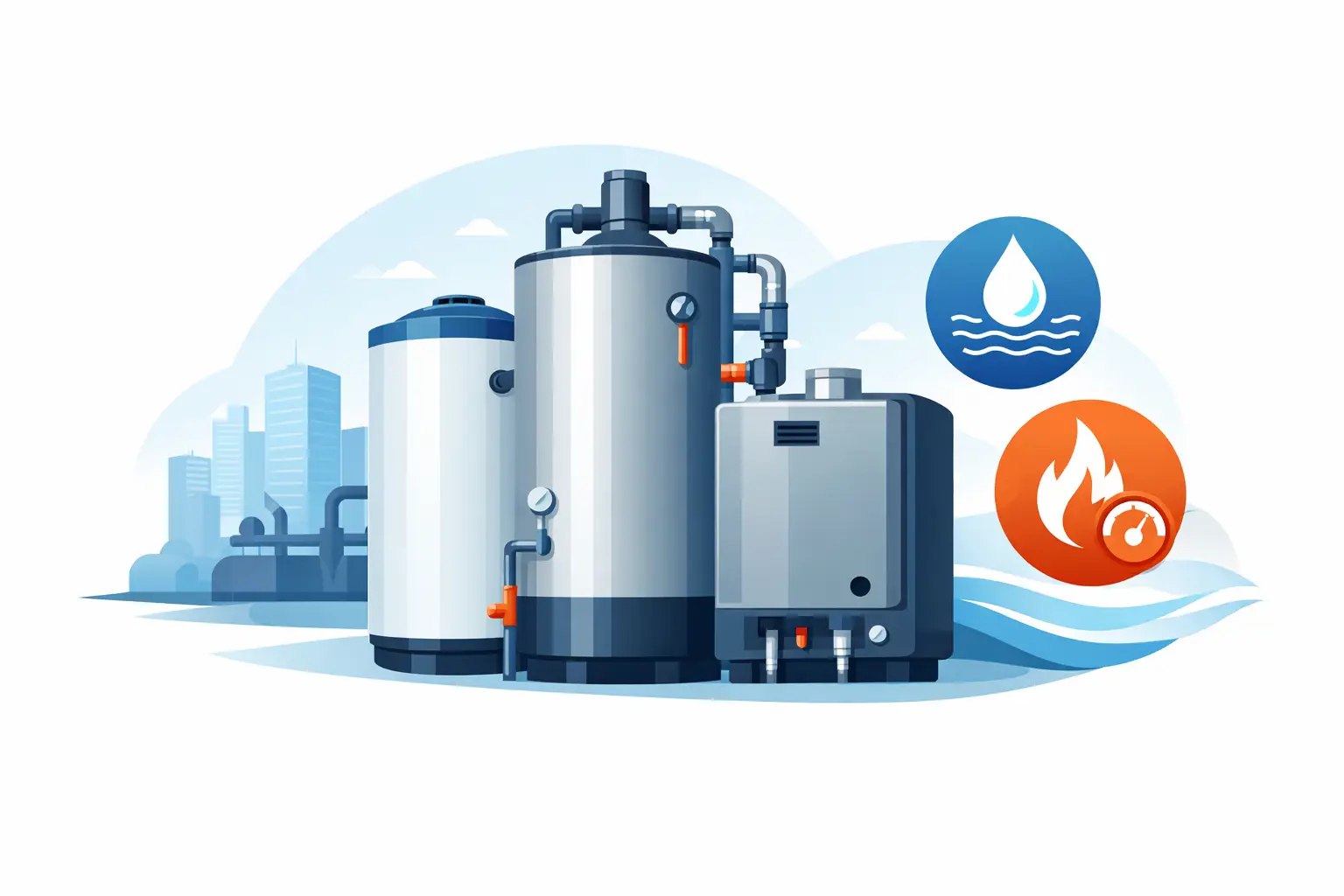
A failed water heater can shut down guest rooms, delay kitchen service, disrupt tenant comfort, and create expensive downtime fast. That is why a commercial water heater review should focus on more than brand names. The right choice comes down to demand, recovery rate, fuel type, maintenance needs, and how much interruption your building can afford.
For most businesses, the real question is not simply which unit is best. It is which system fits the building, the usage pattern, and the risk level. A restaurant, apartment building, gym, and small office can all need commercial hot water, but they do not need the same equipment.
What matters most in a commercial water heater review
Commercial water heaters are work equipment. They are not judged only by purchase price. They are judged by whether they keep hot water available during busy hours, how efficiently they operate, and how easy they are to service when something goes wrong.
The first factor is demand. A unit that handles a light office break room may fail badly in a salon or medical setting. Peak demand matters more than average demand because hot water problems usually show up during the busiest part of the day.
The second factor is recovery. Storage tank systems hold hot water in reserve, while tankless and boiler-based systems produce it differently. If the heater cannot recover quickly after heavy use, complaints show up fast.
The third factor is reliability under real conditions. Hard water, inconsistent maintenance, poor venting, and undersizing all shorten equipment life. In Nevada, mineral buildup can become a serious issue, so maintenance is not optional if you want the system to last.
Commercial water heater review by system type
Tank commercial water heaters
Tank-style commercial water heaters are still a common choice because they are predictable and relatively straightforward to replace and service. They store a set volume of heated water and recover as hot water is used.
For many businesses, this is the practical middle ground. Small restaurants, retail spaces, and moderate-demand properties often do well with a properly sized tank unit. If usage is steady rather than extreme, a tank system can be cost-effective and dependable.
The trade-off is standby heat loss and finite storage. If demand spikes beyond what the tank and burner can keep up with, users notice it quickly. A tank model that looks affordable on paper can become a problem if the building outgrows it.
Tankless commercial water heaters
Tankless commercial units appeal to buyers looking for efficiency and space savings. They heat water on demand instead of storing it, which can reduce wasted energy in the right application.
These systems can work well in smaller commercial settings with controlled demand, or in buildings designed around multiple units working together. They are also useful where floor space is limited.
The catch is that tankless systems are more sensitive to sizing, water quality, and installation quality. If the incoming water temperature, gas supply, or fixture demand is not calculated correctly, performance drops. In high-demand commercial buildings, one undersized tankless setup can create ongoing frustration.
High-input gas commercial systems
For facilities that cannot afford to run short on hot water, high-input gas systems are often the strongest option. These units are built for faster recovery and heavier use. They are common in hospitality, food service, multifamily buildings, and facilities with steady hot water demand throughout the day.
Their main advantage is output. They can keep up where lighter-duty systems cannot. They are often the better fit when operational reliability matters more than the lowest upfront cost.
The downside is installation complexity, venting requirements, and fuel infrastructure. Gas supply sizing and safe installation matter here. A strong heater on weak gas service will never perform the way it should.
Boiler and indirect systems
Some larger properties use boilers with indirect storage tanks or integrated commercial hot water designs. These setups can be highly effective in larger buildings or properties with existing hydronic infrastructure.
They make sense when the building already has the right mechanical setup or when hot water demand is large and continuous. But they are not the default answer for every property. Installation and controls are more involved, and service requires the right experience.
How to judge sizing without guessing
Sizing mistakes cause many commercial water heater failures. The most common problem is buying based on gallon capacity alone. That does not tell you enough.
A useful review looks at first-hour delivery, recovery rate, fixture count, occupancy, and peak-use periods. A small office with two restrooms does not need the same design as a busy café with dishwashing, hand sinks, and employee use compressed into lunch and dinner rushes.
This is where business owners and property managers benefit from a site-specific evaluation. Real sizing should account for how the building operates, not just the square footage. If a contractor skips usage questions and jumps straight to a model recommendation, that is a warning sign.
Fuel type, operating cost, and long-term value
Gas is often the preferred fuel for commercial water heating because it usually offers stronger recovery and lower operating cost than electric resistance units. That is especially true in heavier-demand applications.
Electric commercial water heaters can still make sense in smaller buildings, sites without gas access, or installations where venting is difficult. They are often simpler in some respects, but operating costs may be higher depending on usage and utility rates.
A good commercial water heater review balances upfront cost against total cost of ownership. The cheapest unit to install may become the most expensive one to operate or replace early. Likewise, the most expensive model is not always the best value if the building will never use its full capacity.
Reliability depends on installation more than many buyers realize
A quality unit installed poorly will still perform poorly. That is one of the biggest reasons online product comparisons only tell part of the story.
Commercial water heaters need correct venting, gas pressure, water pressure control, expansion management, code-compliant safety devices, and access for service. Recirculation systems may also need to be reviewed if the building has long pipe runs or slow hot water delivery.
For business owners, this means the contractor matters as much as the equipment. An experienced installer should look at the full system, not just swap one box for another. That is especially important in older buildings where previous shortcuts can create repeated failures.
Maintenance should be part of the buying decision
The best commercial water heater is the one your team can keep running with reasonable service intervals and predictable upkeep. Every system needs maintenance, but not every system needs the same level of attention.
Tank units need flushing, burner inspection, anode checks where applicable, and scale management. Tankless systems usually need more consistent descaling in hard water conditions. Larger gas systems need combustion and venting checks. If maintenance is ignored, efficiency drops and component wear accelerates.
In the Reno-Sparks area, mineral scale is a practical concern, not a theory. That makes service access, drain setup, and water quality planning more important than they may seem during the buying stage.
Which option is usually best?
For many small to mid-sized commercial properties, a properly sized gas tank water heater remains the most balanced choice. It offers dependable output, simpler service, and fewer surprises than more complex systems.
For businesses with variable but lighter demand, commercial tankless can be a solid option if the system is engineered correctly. For high-demand facilities, high-input gas systems or more advanced commercial hot water designs are usually the better path.
There is no single winner in a commercial water heater review because the best unit depends on how the building uses hot water, what utility setup exists, and how much downtime the business can tolerate. A restaurant owner, apartment manager, and office administrator should not be shopping with the same checklist.
If you are replacing a failing unit, this is also the time to ask whether the old system was ever right for the building. Replacing like for like is easy, but it is not always smart.
A dependable commercial hot water system should disappear into the background of your operation. If employees, tenants, guests, or customers are thinking about your water heater, it is usually because something has already gone wrong. The better approach is to choose a system that fits the job, install it correctly, and service it before it becomes an emergency.
Leave a Reply